Friday
09.2026

Useful Vietnamese and Hmong Phrases for the Ha Giang Loop
27 Oct - 2026
A handful of basic Vietnamese phrases will take you much further on the Ha Giang Loop than any translation app ever could.
The moment you leave the provincial city behind, English quickly becomes rare. Along the mountain passes, you will meet local vendors roasting corn on Ma Pi Leng, mechanics at roadside pumps in Yen Minh, and ethnic hosts welcoming you into their Du Gia homestays. Most of them speak little to no English.
You certainly do not need to become fluent before your trip. Surviving and thriving on the loop only takes about twenty essential words, an open smile, and a willingness to use body language.
Below is the exact phrase cheat sheet we share with close friends before their first ride, complete with correct spellings, practical phonetic guides, and the exact contexts where each line comes in handy.

In Ha Giang city, hostels, tour offices and some cafés speak good English. Dong Van old town and the main stops in Meo Vac and Yen Minh get by. Beyond that, expect very little.
Children are the exception. Every village has a group who will shout “hello!” as you ride past, and wave until you wave back. Their parents and grandparents mostly speak their own language first, often Hmong, Tay or Dao, and Vietnamese second.
That last point is worth knowing. For many people up here, Vietnamese is also a learned language. They are used to speaking it slowly and simply with outsiders. Your bad Vietnamese will not sound as strange as you think.
Vietnamese is a tonal language, meaning a single syllable changes its entire meaning depending on the pitch you use.
Naturally, nobody expects you to master these tones in just a week, so do not stress over getting them perfect. Focus on speaking each word clearly and using hand gestures for context. Locals are remarkably good at piecing together what you mean.
The pronunciation notes below are practical English approximations of the Northern accent, which is the dialect spoken across Ha Giang. Treat them as a handy starting point for the road, not a formal language exam.
| English | Vietnamese | Say it roughly like | When you need it |
|---|---|---|---|
| Hello | Xin chào | sin chow | Arriving anywhere |
| Thank you | Cảm ơn | gahm un | Every meal, every fill-up |
| Sorry / excuse me | Xin lỗi | sin loy | Squeezing past, getting attention |
| Yes / no | Có / Không | gaw / khom | Answering anything |
| How much? | Bao nhiêu tiền? | bow nyew tee-en | Markets, stalls, pumps |
| Delicious | Ngon quá | ngon kwa | To your host, after dinner |
| Toilet? | Nhà vệ sinh? | nya vay sing | Petrol stations, cafés |
| Not spicy | Không cay | khom kai | Ordering food |
| I am vegetarian | Tôi ăn chay | toy an chai | Homestays, restaurants |
| Goodbye | Tạm biệt | tahm bee-et | Leaving the homestay |
If you only learn two, make them xin chào and cảm ơn. Said with a smile, they change how a whole village greets you.
These are the practical ones, for when you are riding on your own and something needs sorting.
Xăng (sahng) means petrol. At a pump, đầy bình (day bing) means fill the tank. In villages without a station, ask for xăng at any shop with bottles on the shelf.
Sửa xe (suh-uh seh) is the sign you look for when the bike has a flat tyre or a loose chain. It means motorbike repair, and every village has one, often just a man with a compressor under a tarpaulin.
Đường đi…? (duong dee) means “the road to…?” Add the next town, as in Đường đi Đồng Văn?, and point the way you think it goes. People will point back.
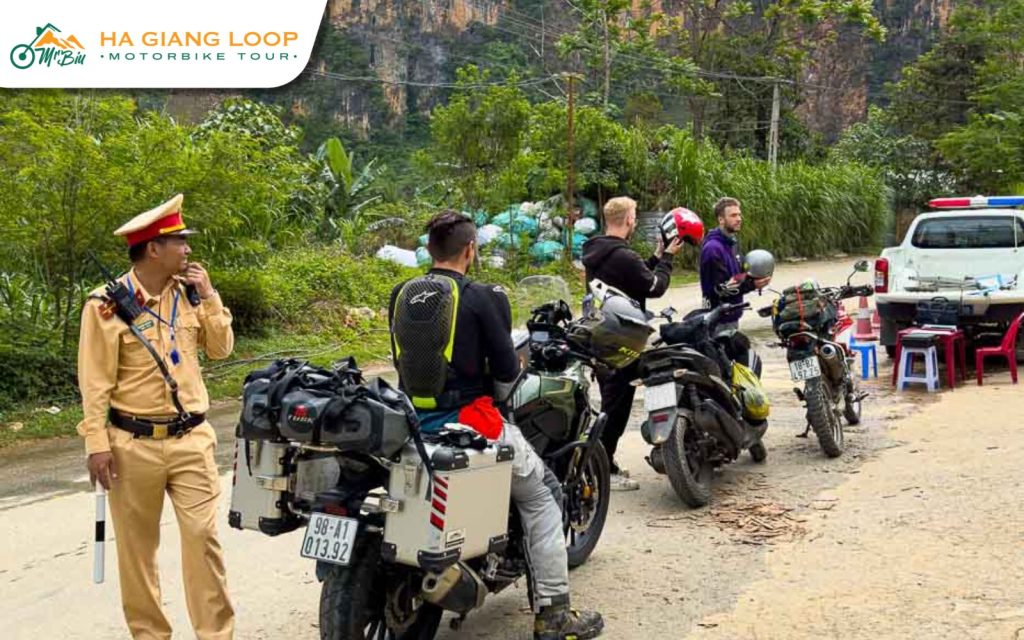
At a checkpoint, start with xin chào, stay calm, and hand over your documents. Officers deal with foreign riders every day. Our page on police checkpoints on the Ha Giang Loop covers what they ask for.
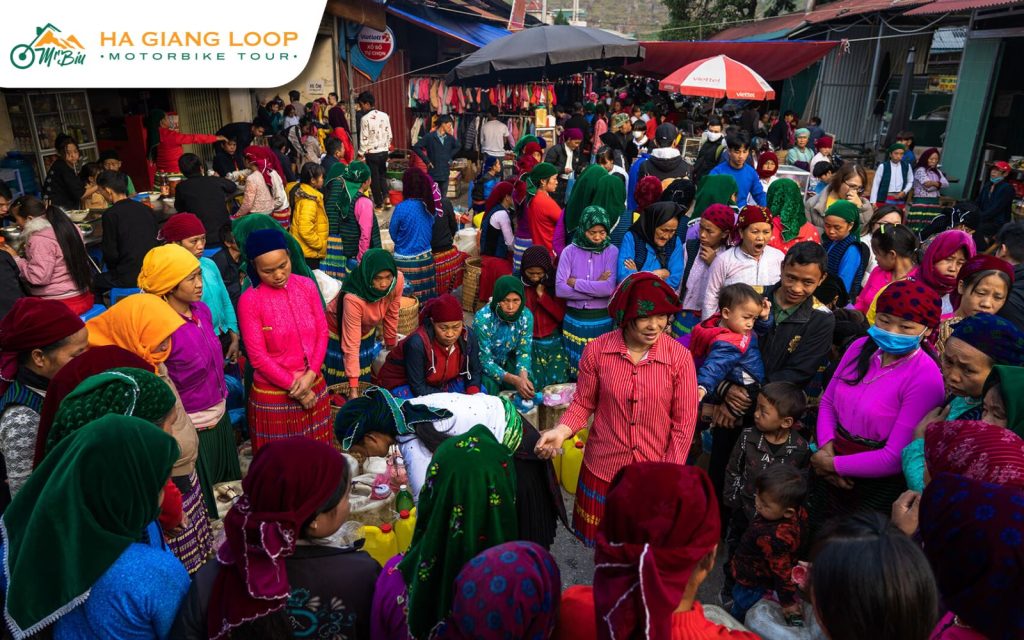
Prices in Vietnam have a lot of zeros, and in conversation people drop most of them. A seller who says ba mươi (ba muoi, “thirty”) at a stall almost always means 30,000 VND. Năm mươi (nam muoi) is 50,000. Một trăm (mot cham) is 100,000.
Learn one to ten and most prices make sense. The numbers are một, hai, ba, bốn, năm, sáu, bảy, tám, chín, mười (mot, hai, ba, bon, nam, sau, bay, tam, chin, muoi). If you get lost, hand over your phone and let them type the number into the calculator. Everyone does it.
Most small shops, markets and pumps on the loop are cash only. Our guide on Ha Giang Loop cuisine has the dishes worth pointing at once you know how to ask the price.
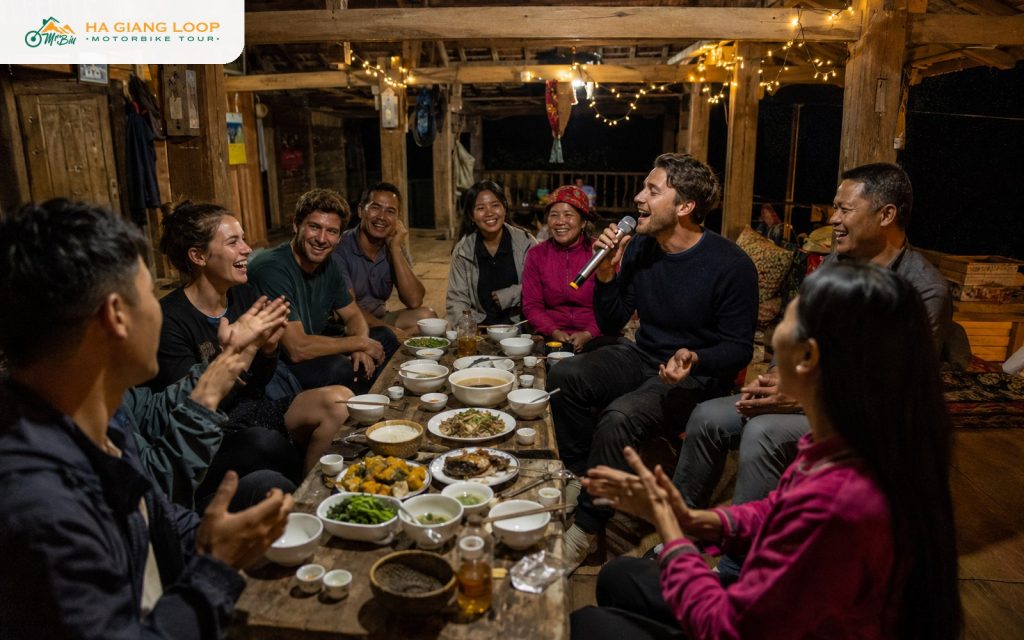
Dinner at a homestay is where the language barrier disappears, mostly thanks to rice wine. Your host will pour, and somebody will raise a glass.
The toast is một, hai, ba, dô! (mot, hai, ba, yo!). One, two, three, drink. It is shouted, not said. You will hear it many times.
Chúc sức khỏe (chook suk kweh) means “to your health”, a slightly politer toast for an older host. No rồi (naw zoy) means “I’m full”, useful when the bowls keep coming. And when you have had enough happy water, a hand over the glass and thôi (toy), “that’s enough”, works better than any excuse.
Our list of the best homestays in Ha Giang has the places where these evenings tend to happen.
Hmong people make up the largest group on the Dong Van plateau. Their language is completely different from Vietnamese, and there are several dialects in Ha Giang. A local will probably smile at your attempt either way.
The greeting most often taught to visitors is nyob zoo, said roughly “nyaw zhong”. The thank-you is ua tsaug, roughly “oo-ah chow”. These are written in the standard Hmong spelling used internationally, so local pronunciation may sound a little different from what you read.
Try them with a grandmother at a market in Dong Van, or with your host in Lung Cam. If you get a blank look, switch to xin chào. Almost everyone understands it.
Our guide to Ha Giang Loop ethnic communities explains who lives where along the route.
If there is one phrase we wish every traveller learned before visiting Ha Giang, it is this one: Chụp ảnh được không? (pronounced choop ang duok khom?), which translates to “Can I take a photo?”
When you say it, raise your camera slightly so your intention is immediately clear.
Reading the response is straightforward. A nod gives you the green light, while a head shake, a raised hand, or a turned face means no and a refusal should always be respected immediately.
In local highland markets, some elderly women may ask for a small tip in exchange for a portrait, while others simply prefer to keep their privacy. If you want to handle these cultural moments with care and confidence, take a look at our comprehensive guide to being a responsible tourist in Ha Giang.
Phrases get you through a meal and a fill-up. They do not get you a long conversation with a Hmong farmer about the corn harvest, or the story behind a homestay family’s house. That is where a local guide changes the trip.
Our guides grew up in Ha Giang and many speak a local language as well as Vietnamese and English. When you travel with a local Mr. Biu guide, they translate at dinner, explain what the market is selling and help you ask the questions you could not ask alone. On our three-day route, you spend two nights with host families in Dong Van and Du Gia, and both evenings tend to end with một, hai, ba, dô.

Mr. Biu is a family business from Ha Giang. Groups stay small, at 8 to 9 people, so there is time to stop and talk at the places that matter. Everyone who books gets a free dorm bed at our hostel the night before the tour.
Quan Ba, Lung Cam, Dong Van, Ma Pi Leng and Du Gia over about 330 km, with two homestay nights. From 2.850.000đ ($114) sitting behind a friend, 3.190.000đ ($128) driving yourself, or 4.000.000đ ($160) with an easy rider.
Three homestay nights, plus Lung Cu Flag Pole and a Lo Lo village, over about 440 km. From 3.850.000đ ($154), 4.050.000đ ($162) driving yourself, or 4.900.000đ ($196) with an easy rider.
See both trips on our tours page or book online. Questions? Message us on WhatsApp at (+84) 3272 58338 or email mrbiu.booking@gmail.com.
English is widely spoken across Ha Giang City and throughout traveller hostels.
Once you head out onto the loop, you will encounter basic English in key transit towns. In more remote mountain villages, English is virtually non-existent, though you can always count on local children welcoming you with energetic shouts of “hello.”
Without question, it is Cảm ơn (thank you).
Paired with a warm smile and spoken frequently, this simple courtesy will open doors and build instant goodwill faster than any other phrase.
The standard greeting taught to travellers is nyob zoo (pronounced roughly like “nyaw zhong”).
Keep in mind that Hmong dialects vary considerably across the province. If you find yourself unsure, a friendly Xin chào in Vietnamese is always an easy, reliable fallback.
The universal cheer is “Một, hai, ba, dô!” (one, two, three, drink!).
Expect to hear this lively chant echo around the table at nearly every family dinner and homestay gathering along the route.
Fluency is definitely not required, but knowing a handful of practical terms makes refuelling, ordering food, and finding directions significantly smoother.
Mobile reception drops frequently along the high mountain passes, so be sure to download an offline Vietnamese language pack on your translation app before leaving the city.