Thursday
10.2026

Petrol Stations on the Ha Giang Loop: Where to Refuel
20 Oct - 2026
Petrol stations on the Ha Giang Loop are easy to find in town and surprisingly rare in between. The riders who run dry are rarely careless. They just did the maths for a flat road, then spent the afternoon climbing in second gear with a backpack strapped to the rack.
This guide covers where the pumps are and how far a rental bike really goes on one tank. It also flags the few stretches where you need to plan ahead. It is written for self-riders. If you ride with us, fuel is already in the price, and we will come back to that at the end.
Most rental bikes on the loop are small Honda semi-automatics. A Blade or Wave 110 holds a little under four litres. A Future 125 holds a bit more, around four and a half. The tanks are small because these bikes were built for town errands, not for 120 km days in the mountains.
On paper, a 110cc bike can cover close to 150 km on a full tank. On the loop, plan for 100 km and treat anything after that as a bonus. Long climbs, a passenger, luggage and cold mornings all pull that number down. A rider carrying a friend up Ma Pi Leng uses noticeably more fuel than the same bike on the flat road out of the city.
Bigger bikes like the Honda XR 150 have a much larger tank, so range is rarely a worry on them. The rule below is written for the small bikes, because that is what most people ride.
Our rule: fill up whenever the gauge drops below half and you pass a proper station. Do not wait for the reserve light.
Every town on the loop has at least one station. The gaps are in the villages between them. Below is how it looks in practice, starting from Ha Giang city. The Ha Giang Loop map shows the same towns in order if you want to follow along.
| Stage | Where to fill up | What to know |
|---|---|---|
| Ha Giang city | Several stations along the main roads | Leave with a full tank, every time. |
| Quan Ba (Tam Son) | Station in town | About 45 km from the city, after Bac Sum Pass and Heaven Gate. |
| Yen Minh | Stations in town | The last easy fill before the plateau. Top up here even if you are half full. |
| Dong Van | Stations in town | Fill up before Lung Cu and before Ma Pi Leng. There is no pump at the flag tower. |
| Meo Vac | Stations in town | The last reliable pump before the long road south towards Mau Due and Du Gia. |
| Mau Due to Du Gia | Small town pumps, bottle sellers | Do not count on finding a station open in Du Gia. Arrive with fuel. |
| Du Gia to Ha Giang via Thai An | Few on the back roads | Fill in Meo Vac or Mau Due the day before. Bottle fuel exists in villages. |
The tight stretches are the ones that matter. The plateau between Yen Minh and Dong Van has fuel, but the side trips do not. Lung Cu is a dead end with no station. The southern half of the loop, through Du Gia, Duong Thuong and Thai An, has the longest quiet roads and the fewest pumps.

In villages you will see shop fronts with plastic or glass bottles lined up on a shelf or a small table. That is petrol, sold by the litre. It is how farmers fill their bikes when the nearest station is an hour away.
Bottle fuel works in a pinch. It costs more than the pump, often noticeably more, and quality varies. Some of it has sat in the sun for days. Use it to reach the next town, not as your plan. Buy one bottle, ask the seller to pour it in, and carry on to a real station.
If you cannot see bottles, ask. In a village, the word for petrol is xăng, said roughly like “sahng”. Pointing at your tank works just as well.
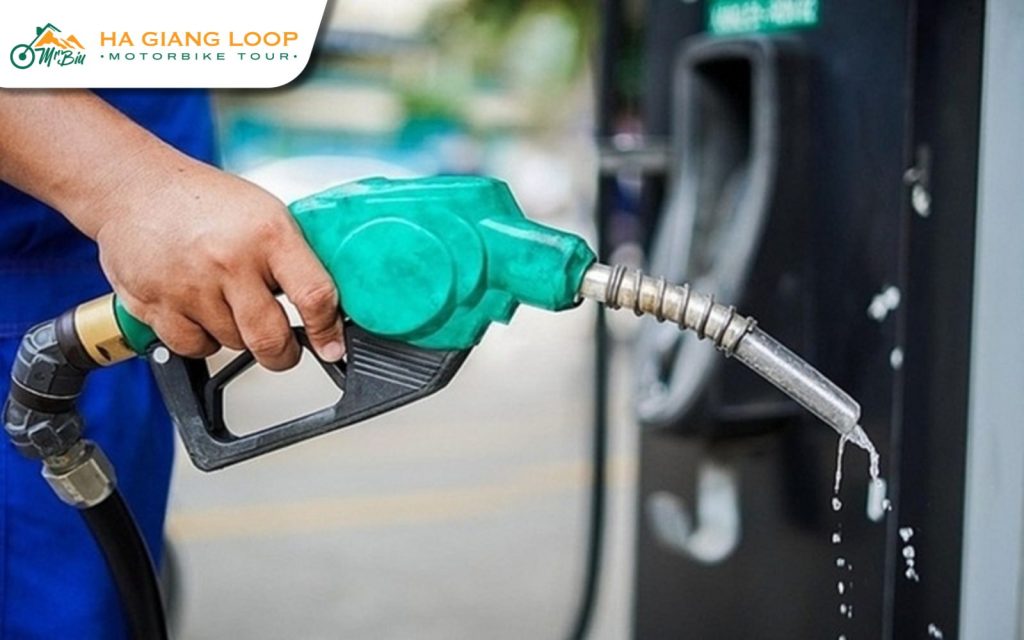
Stations on the loop are staffed. You do not fill the bike yourself. Pull up, open the seat (on most Hondas the tank cap sits under it), and tell the attendant how much you want. Đầy bình (said roughly “day bing”) means fill it up.
The price per litre is on a board by the pumps, in VND. Retail prices are set nationally and published by Petrolimex, the largest fuel retailer, so a litre costs the same in Dong Van as in Hanoi. Most stations sell two grades: RON 95 and E5 RON 92. Either is fine for a rental Honda. A full tank on a 110cc bike costs well under 100,000 VND, so keep small notes ready.
Cash is the only safe assumption. A few stations in Ha Giang city take cards or bank transfer, but up on the plateau it is notes only. Our guide to how much cash to bring on the Ha Giang Loop has a full daily budget, fuel included.
It happens to someone most weeks. The engine coughs, picks up, coughs again, then stops on a slope with nothing in sight.
First, check you are really out. Look at the gauge, then the red kill switch on the right handlebar. A knee or a bag strap flicks it more often than you would think. Our guide to a bike breakdown on Ha Giang Loop walks through the other quick checks.
If it is fuel, the usual fix is simple. Flag down a local rider and show them the empty tank. More often than not, someone will ride to the nearest village and come back with a bottle, or tow you with a foot on your rear peg. Pay them for the fuel and their time. Do not push the bike uphill for an hour out of pride.
Which way you ride the loop changes where you need to be careful.
Riding clockwise, through Quan Ba and Yen Minh first, you have towns close together on day one. The tight part comes later, on the way back through Du Gia and Thai An, when riders are relaxed and stop checking the gauge.
Riding anti-clockwise, through Thai An and Du Gia first, the quiet roads come on day one, when you are still learning the bike. Leave Ha Giang city full and you will reach Du Gia comfortably. The day after, fill up in Mau Due or Meo Vac before the climb to Ma Pi Leng.
Either way, the most common mistake is passing a station because the tank still looks fine. It made our list of things not to do on the Ha Giang Loop for a reason. Our pages on Yen Minh town and Meo Vac town are worth a read for the two fill-ups that matter most.
Every bike on our tours leaves Ha Giang city with a full tank, and fuel for the whole trip is included in the price. The guide knows which station is open, which one has been closed for repairs since last month, and where the last pump before Du Gia is. You will stop to refuel, but you will never have to work out when.
If you are weighing up riding alone against riding in a group, that is one of the small things that adds up. On our guided three-day trip, the stops are planned around the long stretches before you reach them. The same goes for the four-day route, which adds the dead-end ride up to Lung Cu.
Mr. Biu is a family business from Ha Giang, and our guides have been riding these roads their whole lives. Groups stay small, at 8 to 9 people, and everyone who books gets a free dorm bed at our hostel the night before the tour. Read more about us on the Mr. Biu Tour Ha Giang homepage.
Quan Ba, Dong Van, Ma Pi Leng, Du Gia and Thai An over about 330 km, with two homestay nights. From 2.850.000đ ($114) sitting behind a friend, 3.190.000đ ($128) driving yourself, or 4.000.000đ ($160) with an easy rider.
The same highlights at an easier pace, plus Lung Cu Flag Pole, a Lo Lo village and Lung Khuy Cave, over about 440 km and three homestay nights. From 3.850.000đ ($154), 4.050.000đ ($162) driving yourself, or 4.900.000đ ($196) with an easy rider.
See both trips on our tours page or book online. Questions? Message us on WhatsApp at (+84) 3272 58338 or email mrbiu.booking@gmail.com.
Yes, provided that you refuel in major towns. Each district center along the standard route has operational petrol stations. However, fuel supplies are considerably sparser along detour routes such as Lung Cu, as well as on quieter southern stretches connecting Du Gia and Thai An.
For standard 110cc or 125cc motorbikes, we recommend topping up whenever your fuel gauge drops below half and a station is accessible. In practice, this generally requires refueling once or twice per day depending on the terrain.
Yes. All motorbikes depart with a full tank, and complete fuel coverage for the entire itinerary is included across all tour options.
Card payments are not widely supported. While selected stations in Ha Giang City may process cards or bank transfers, stations along the mountain loop operate almost exclusively on cash. Travelers should carry sufficient cash in small denominations.
Bottled fuel serves reliably as an emergency reserve to reach the next town. However, prices are higher than pump rates and fuel quality is inconsistent. It should only be used as a short-term solution rather than a primary refueling method.