Thursday
10.2026


Hospitals and Medical Care on the Ha Giang Loop
21 Oct - 2026
Medical care along the Ha Giang Loop is often better than anxious riders expect, yet far more limited than many assume.
While almost every small town has a clinic ready to clean and dress a minor scrape, finding a facility equipped to handle a serious fracture is an entirely different story. Knowing where to turn before an emergency strikes is crucial – and that is exactly why we put this guide together.
We aren’t doctors. We’re a local tour crew who have spent years navigating these mountain passes, dealing with everyday road rash, scrapes, and occasionally more severe incidents.
In this guide, we share our first-hand experience on the medical landscape of the Loop: where to find proper treatment, what essential supplies to pack, and what immediate steps to take during that critical first hour after an incident.

Care on the loop comes in three levels, and it helps to know them apart.
The main hospital is the general hospital in Ha Giang city. It has an emergency department, X-ray and surgeons. For anything more than a cut or a sprain, this is where you end up, wherever on the loop it happened.
Each of the old district towns has a health centre: Tam Son in Quan Ba, Yen Minh, Dong Van and Meo Vac all have one. These can clean and stitch wounds, splint a suspected fracture, put you on a drip and stabilise you for transfer. They are not equipped for complex surgery.
Most villages have a small commune health station, staffed by a nurse or a doctor. It is fine for cleaning a graze, getting a dressing or checking a fever. Opening hours are not always predictable.
For anything life-threatening, patients are usually moved to Ha Giang city first, and sometimes on to Hanoi. Hanoi is roughly 300 km away by road. That distance is the real reason to ride carefully up here.
Here is how it looks if you ride the loop clockwise, through Quan Ba first. The Ha Giang Loop map has the same towns in order.
The first 45 km, up Bac Sum Pass to Quan Ba, are never far from the city hospital. Tam Son has a health centre and pharmacies. Yen Minh, around lunchtime on most itineraries, has the same.
The plateau between Yen Minh and Dong Van is where help gets further apart. Tham Ma Pass and the road through Sung La have villages, but nothing beyond a commune health station. Dong Van town has a health centre and several pharmacies around the market.
Ma Pi Leng sits between Dong Van and Meo Vac, both with health centres. It is the most dramatic road on the loop and, in our experience, not where most accidents happen. Riders are careful there. The trouble tends to come later, on the long descents when people relax.
The southern half, through Mau Due, Du Gia and back via Thai An, is the most remote. Du Gia has a commune health station but no hospital. From Du Gia, Ha Giang city is a long ride back over the passes.
Big crashes make the news, but they are not what fills a first-aid kit. These are the things we see most.
Exhaust burns. The hot exhaust pipe on the right side of the bike burns a neat oval into a bare calf. It happens getting off the bike, usually on day one, usually in shorts. Locals call it the Vietnamese tattoo. Wear long trousers and always step off on the left.
Low-speed slides. Gravel on a bend, a wet patch of concrete, a sudden stop for a photo. Most crashes on the loop happen below 30 km/h. The result is grazed hands, elbows and knees, and sometimes a twisted wrist or ankle.
Stomach trouble. New food, long days and a few glasses of happy water at the homestay. Usually a day of discomfort, nothing more.
Cold and dehydration. From November to February, mornings on the plateau can be close to freezing, and the wind on a bike makes it worse. In summer it is the opposite. Both make riders tired, and tired riders make mistakes.
If you are traveling with a guide, let them handle the situation. If you are riding solo, following these exact steps will keep you safe and prevent things from escalating:
1. Clear the road immediately
Move yourself and your motorcycle off the tarmac as fast as you safely can. Curves on the Loop feature severe blind spots, and heavy trucks swing around them without warning.
2. Assess your body before standing up
Take a moment to check yourself over before attempting to get on your feet. If you feel any sharp pain in your neck or spine, do not move – stay still and wait for assistance.
3. Call 115 or ask a local for help
Dial 115 for medical emergencies (113 is for police, 114 for fire). Because dispatchers rarely speak fluent English, flagging down a passing local to make the call often gets help moving much faster.
4. Flush and dress minor grazes
Rinse surface wounds thoroughly with clean bottled water and protect them with a dressing. Mountain road grit leads to rapid infection, so make sure to stop by the nearest commune clinic later that day for professional antiseptic cleaning.
5. Notify your rental shop or agency
Contact the shop that provided your motorcycle. They have direct contacts at nearby clinics, know the terrain intimately, and can dispatch a replacement bike or transport support right away.
6. Document the scene for insurance
Once you are out of harm’s way, take clear photos of your injuries, the vehicle damage, and the surrounding road before moving anything. You will need these records for your claim.
If your injuries are taken care of and you only need help with mechanical damage, refer to our comprehensive guide on handling a bike breakdown on the Ha Giang Loop.
Finding a local pharmacy (nhà thuốc) is straightforward once you reach major hubs like Ha Giang City, Tam Son, Yen Minh, Dong Van, or Meo Vac. Just keep an eye out for the recognizable green cross sign.
Most common treatments and everyday medications are readily available over the counter. If language is a barrier, simply show the pharmacist a photo of the packaging you use back home, or point directly to where it hurts – they are accustomed to travelers and will usually find what you need.
Once you leave town limits, however, roadside pharmacies simply do not exist. To stay self-sufficient between stops, keep a compact medical kit within easy reach in your jacket pocket:
For a full breakdown of gear, clothing, and riding essentials, check out our complete Ha Giang Loop packing list.

Hospital care in Vietnam is affordable by Western standards for small things. A transfer to Hanoi, a private hospital or a flight home is a different story. That is what travel insurance is for, and it is the part we see riders skip most often.
Read the small print before you go. Many policies exclude motorbike riding, or only cover it if you hold a licence valid for the bike, plus an International Driving Permit under the 1968 convention. Some only cover you as a passenger. Our guide to Ha Giang Loop insurance explains what to check.
To be clear about our own tours: the bikes are insured, but personal travel insurance is not included in the price. You need your own.
The honest way to lower your odds of needing this guide is to not drive. Most of the injuries above come from riders who are new to semi-automatic bikes or new to mountain roads. Our Ha Giang Loop safety guide goes through the risks in more depth, and female safety on the Ha Giang Loop covers a few more.
Sitting behind a local driver removes most of it. You still see Ma Pi Leng, you still stop at every viewpoint, but someone who has ridden these roads since childhood handles the gravel and the trucks. Our guide for pillion passengers on the Ha Giang Loop covers how to sit, what to wear and how to talk to your driver. Riding behind an experienced local driver is also what we suggest for anyone with a bad back or knees. The same goes for any condition that makes a fall more serious.
If something goes wrong on our guided three-day loop, the guide calls ahead to the nearest health centre. They ride there with you and stay to translate. That last part matters more than people expect.
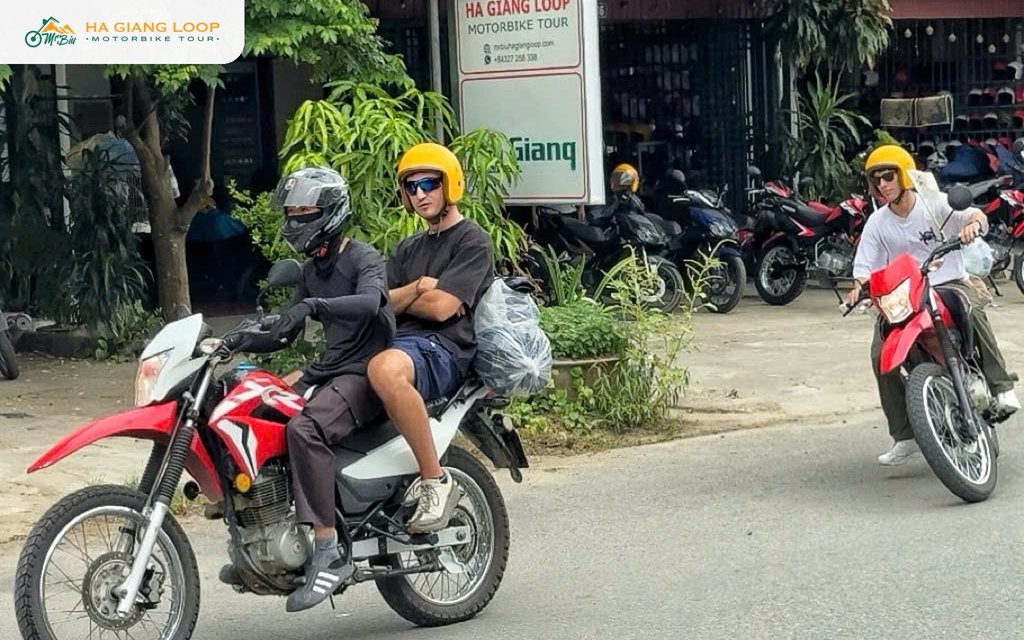
Mr. Biu is a Ha Giang family business, and our guides know the clinics, pharmacies and doctors along the route as well as they know the roads. Groups stay small, at 8 to 9 people, so the guide can keep an eye on everyone. Find out more on the Mr. Biu Tour Ha Giang homepage.
Quan Ba, Dong Van, Ma Pi Leng, Du Gia and Thai An over about 330 km, with two homestay nights. From 2.850.000đ ($114) sitting behind a friend, 3.190.000đ ($128) driving yourself, or 4.000.000đ ($160) with an easy rider.
An extra day for a gentler pace, plus Lung Cu Flag Pole and Lung Khuy Cave, over about 440 km. From 3.850.000đ ($154), 4.050.000đ ($162) driving yourself, or 4.900.000đ ($196) with an easy rider.
See both trips on our tours page or book online. Questions? Message us on WhatsApp at (+84) 3272 58338 or email mrbiu.booking@gmail.com.
The largest, best-equipped general hospital is located right in Ha Giang City, where your journey begins and concludes. Along the route, major hubs such as Tam Son, Yen Minh, Dong Van, and Meo Vac feature district health centers fully capable of handling emergency stabilization and primary wound care.
For medical emergencies, dial 115 to request an ambulance. If you need police assistance, call 113, and for fire services, dial 114. Because emergency dispatchers often speak limited English, it is best to ask your tour guide or a nearby local resident to place the call for you.
Yes, you can easily purchase over-the-counter medicine in the larger towns. Look for local pharmacies displaying a prominent green cross sign. However, stretches between towns have no medical shops, so keeping a personal pouch of essential remedies in your pocket is essential.
Our rental fleet comes with vehicle insurance, but personal travel and medical insurance are not included. We strongly recommend reviewing your personal policy before arriving to confirm that it explicitly covers motorbike transit, whether you ride solo or sit pillion.
Exhaust pipe burns on the lower calf and surface abrasions from minor, low-speed slides are by far the most frequent incidents. You can avoid nearly all of them simply by wearing durable long pants, lacing up sturdy shoes, and always dismounting from the left side of the bike.