Sunday
10.2026

Nho Que River Boat Trip: Tu San Canyon Cruise Guide
04 Sep - 2026
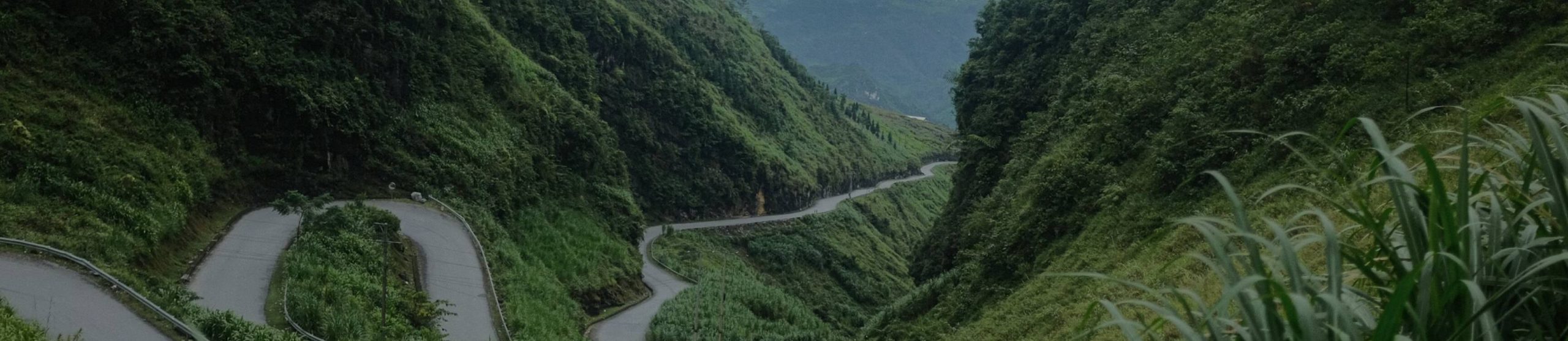
There is a moment on day two of the loop when the road stops climbing, you park the bike at a viewpoint on Ma Pi Leng, and you look down.
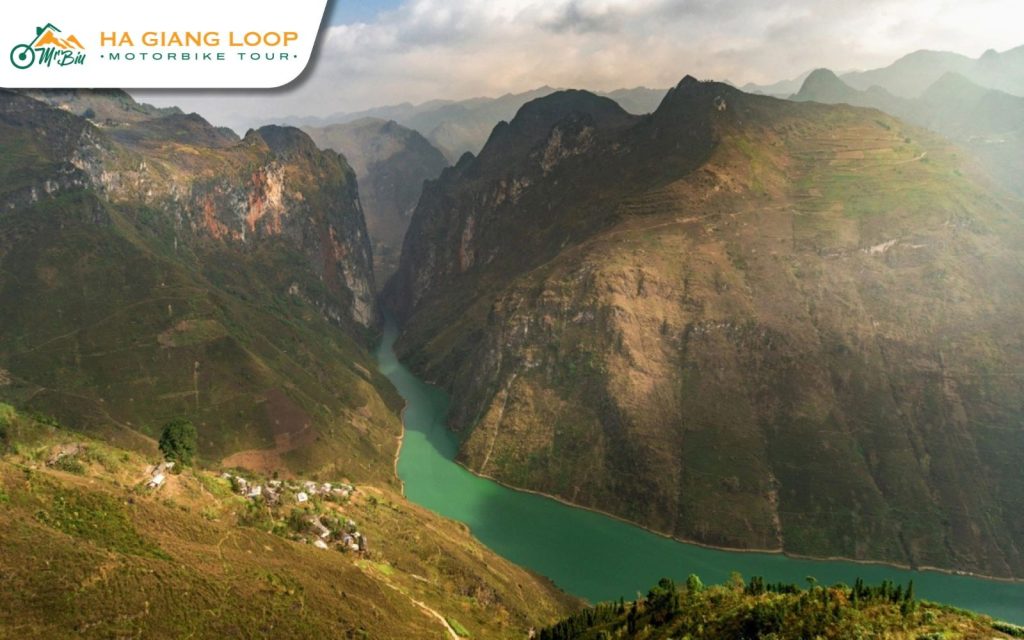
A kilometre below, a river the colour of jade runs between two vertical walls of limestone. That is the Nho Que, and the gap it cuts through is Tu San Canyon — the deepest canyon in Southeast Asia.
Most riders take the photograph and ride on. The Nho Que River boat trip is the option to go down and look up instead, and it is worth understanding before you arrive, because the logistics catch people out.
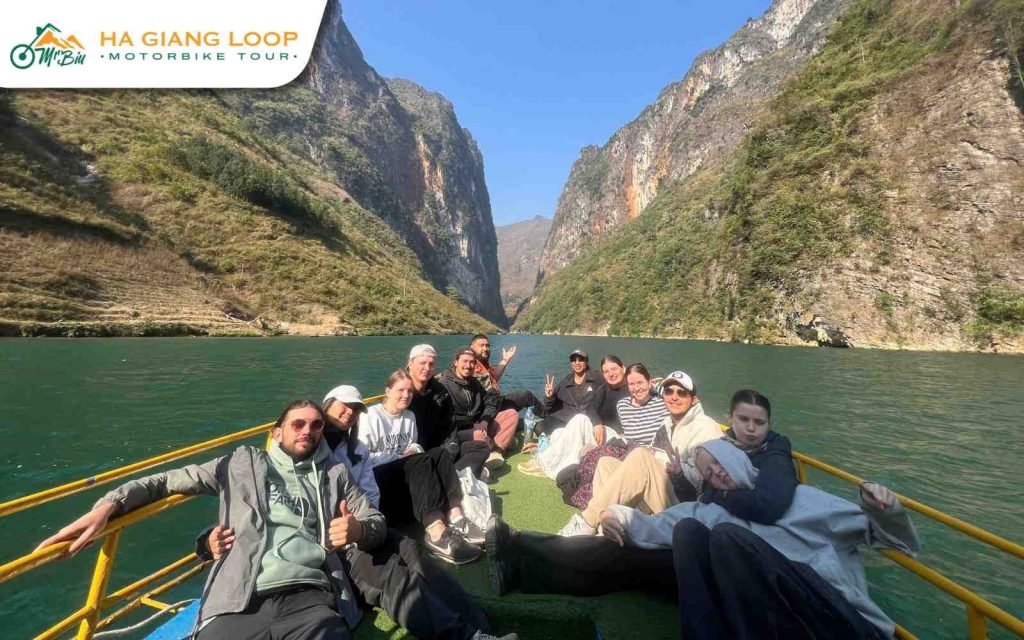
A small motorised boat takes you from a jetty on the Nho Que into the mouth of Tu San Canyon and back. The trip lasts roughly an hour, sometimes a little more depending on how far upstream the boat goes.
The appeal is a change of scale. From Ma Pi Leng the canyon is a beautiful abstraction. From water level it is 700 to 800 metres of rock going straight up on either side of you, and the boat feels very small. Photographs do not really convey it — the sound does. It is remarkably quiet down there.
The boat station sits below Ma Pi Leng Pass, on the stretch between Dong Van and Meo Vac. On both our tours you pass directly above it on day two.
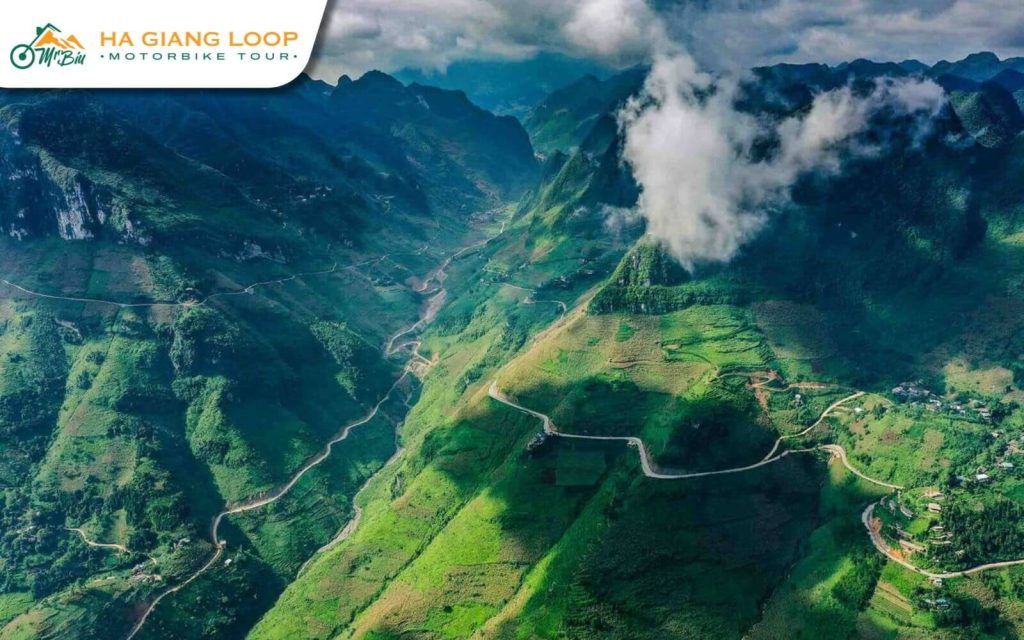
Getting down to the water used to be the awkward part of this trip. It is not any more. A sealed road now runs from the foot of Ma Pi Leng Pass down to the boat station, and it takes both motorbikes and cars without difficulty.
The turning is at the foot of the pass, about 500 metres past the Hmong village of Pa Vi, and it is roughly 5 kilometres down to the boat station from there. At the bottom you park, and a free electric shuttle runs you the last stretch to the boarding area. Nothing about the access is difficult now, whether you are riding yourself, sitting behind an easy rider, or travelling by car.
You do not need to book ahead. Tickets are sold at the jetty on the day.
The fare is 150,000₫ per person. Boats leave when they have enough passengers rather than on a fixed timetable, so there is usually a short wait rather than a set departure time.
Tell your guide the night before if you want to do it, so the day is planned with the time built in. The ticket is paid at the jetty and is separate from your tour price.
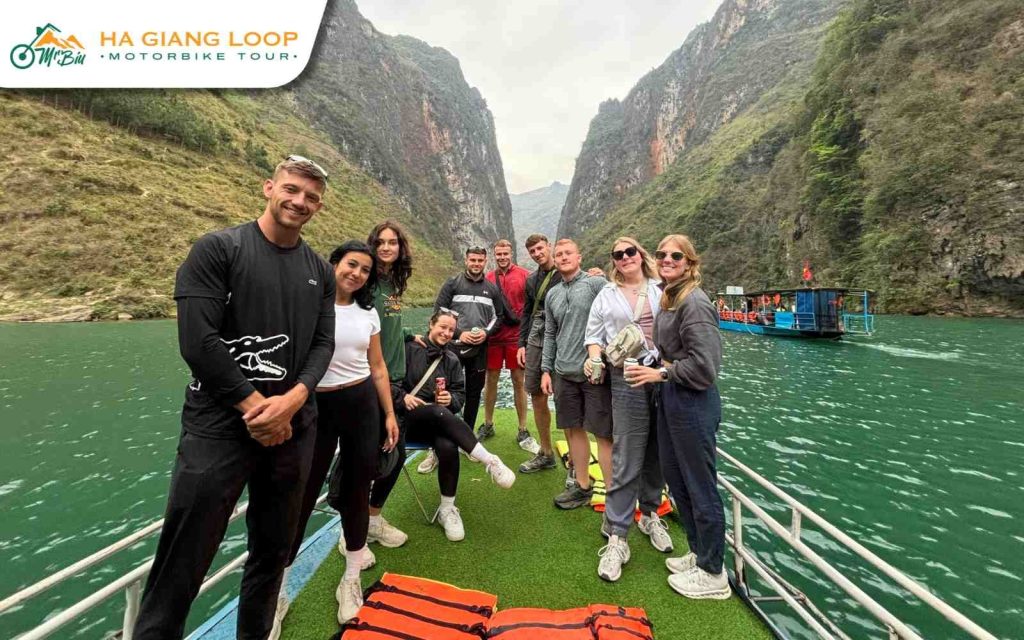
The Nho Que is at its most photogenic when the water is clear and green, which is not all year.
Within the day, late morning to early afternoon is best. The canyon is deep and narrow, so early and late in the day the walls put the water in shadow.
If you are riding in rainy season and the colour matters to you, ask your guide the day before. They will know whether the river is running clear.
Boats are small, open and fitted with life jackets. Wear one. The water is deeper and colder than it looks and there is nowhere to swim to.
Some operators offer kayaks as well as motorboats. Kayaking is a genuinely better experience if you have the time and the arms for it, though it takes considerably longer.
Honest answer: it depends on your time and what you came for.
Do it if you want to experience the canyon rather than photograph it, if you are on the four-day tour and have the slack in your schedule, or if you are the kind of traveller who regrets skipping things.
Skip it if your day is already tight, if the river is brown after heavy rain, or if you would rather spend the hour at the Ma Pi Leng viewpoints. The view from the pass is the more famous image, and it costs nothing.
What we would not do is treat it as compulsory. Plenty of riders finish the loop without going down to the water and do not feel short-changed.
Day two is already the biggest day of the loop, around 110 kilometres of mountain road between Dong Van and Du Gia via Ma Pi Leng and Ngoc Long, in one direction or the other depending on the tour.
Adding the boat trip means roughly an extra hour and a half once you count the ride down, the wait and the ride back up. That time does not fit the three-day loop, which rides Ma Pi Leng on the morning of day two and still has Meo Vac, Mau Due, Ngoc Long and Du Gia ahead before dark, so the boat is not part of that tour. The four-day itinerary has the room for it.
Either way, mention it to your guide at the start of the day rather than at the viewpoint. Ha Giang days work better when the plan is set in the morning.
Both of our tours are run by a local family who have ridden these roads their whole lives. Same circuit, same homestays — the only choice is how much time you want to give it.
The classic loop, ridden clockwise: Quan Ba Heaven Gate, the Dong Van Karst Plateau, Ma Pi Leng, the Du Gia waterfall and Thai An Pass, with two homestay nights. Around 330 km, from $114. Best if your schedule is tight and you still want every headline view.
Everything above plus Lung Cu Flagpole, a Lo Lo village, the Yen Minh pine forest and Lung Khuy Cave, spread over a gentler pace. Around 440 km, from $154. Best if you would rather stop than hurry.
Self-drive or easy rider on both. Message us on WhatsApp at (+84) 3272 58338 or email mrbiu.booking@gmail.com and tell us your dates.
No. Tickets are sold at the jetty on the day. Boats leave once enough passengers have gathered, so expect a short wait rather than a fixed departure time.
About an hour on the water. Allow around an hour and a half in total once you include getting down to the jetty and back up to the road.
No, it is a separate optional activity paid at the jetty — 150,000₫ per person. Tell your guide if you want to do it so the day is planned around it.
Yes. A sealed road now runs from the foot of Ma Pi Leng down to the boat station, about 5 kilometres, and it is fine for motorbikes and cars alike. From the car park a free electric shuttle takes you the last stretch to the boats.
October to April, when rainfall is low. During the summer rains the river runs higher and browner, and after heavy rain boats may not run at all.
Life jackets are provided and should be worn. Operators do not run when conditions are poor. The water is calm; the main risks are dropped phones and underestimating how cold the canyon is.