Thursday
10.2026

Ha Giang Loop 4 Days 3 Nights vs 3 Days 2 Nights: Which Should You Book?
03 Sep - 2026
Almost everyone who writes to us asks the same question before they book: is the extra day worth it?
Both of our tours ride the same legendary circuit, sleep in the same family homestays and cross the same Ma Pi Leng Pass. The difference is not which one shows you more of Ha Giang — it is how hard you want to ride, and whether you want to stand at Vietnam’s northernmost point.
Here is the honest comparison, from the people who ride both routes every week.
Take the 3 days 2 nights tour if you are on a schedule, if you are comfortable with two solid days of five-plus hours in the saddle, and if you want every headline view of the Ha Giang Loop for the lowest price.
Take the ha giang loop 4 days 3 nights tour if you have a spare day, if you would rather stop than hurry, or if Lung Cu Flagpole and Lung Khuy Cave are on your list. The fourth day does not open a new region — it lets you breathe in the one you are already in.
| 3 Days 2 Nights | 4 Days 3 Nights | |
| Total distance | ~330 km | ~440 km |
| Riding per day | 100–120 km · 5–6 h | 100–120 km · 4–5 h |
| Nights | Dong Van, Du Gia | Du Gia, Dong Van, Yen Minh |
| Exclusive stops | — | Lung Cu Flagpole, Lo Lo village, Yen Minh pine forest, Lung Khuy Cave |
| Shared highlights | Thai An Pass · Du Gia waterfall · Ngoc Long rafting · Ma Pi Leng Pass · Nho Que River · Dong Van Karst Plateau · Chin Khoanh · Lung Cam · Tham Ma Pass · Quan Ba Heaven’s Gate · Bac Sum Pass | |
| Self-drive | $128 ≈ 3,190,000₫ | $162 ≈ 4,050,000₫ |
| Easy rider | $160 ≈ 4,000,000₫ | $196 ≈ 4,900,000₫ |
This surprises people, so it is worth saying plainly: both tours ride the same core circuit and sleep in the same two villages, Dong Van and Du Gia, but they ride it in opposite directions. The three-day tour goes clockwise, north through Quan Ba first. The four-day tour goes anti-clockwise, east through Thai An and Du Gia first.
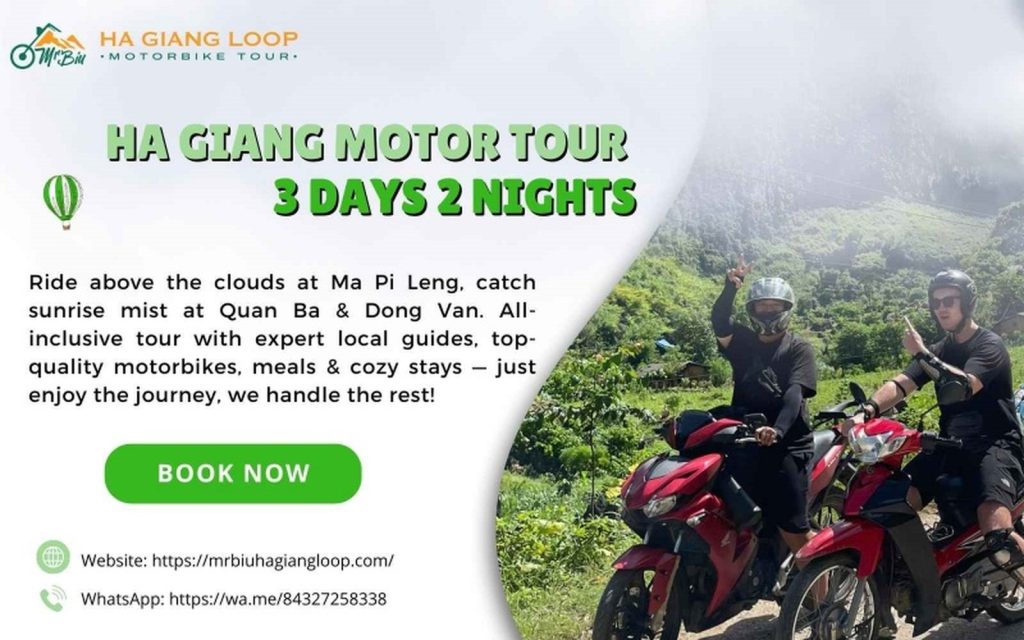
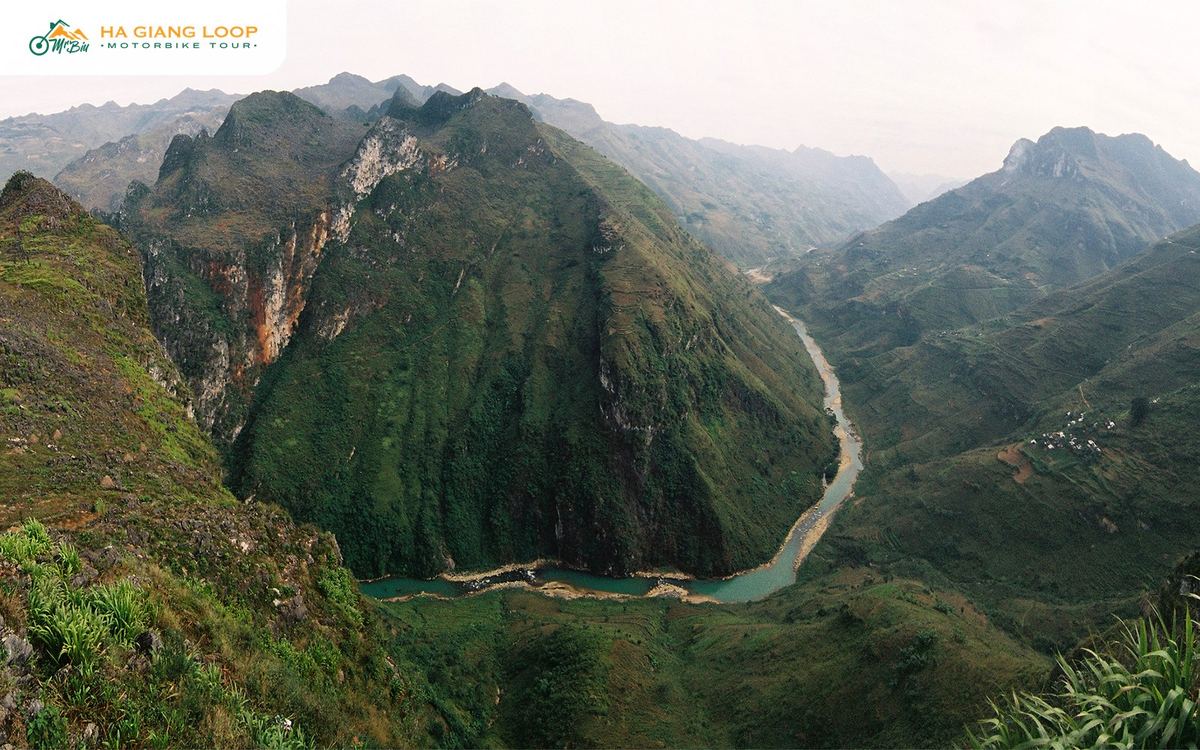
On the three-day tour, day one takes you 120 kilometres north from Ha Giang City over Bac Sum Pass to Quan Ba Heaven’s Gate and the Twin Mountains, lunch in Quan Ba, then up Tham Ma Pass onto the Karst Plateau, through Lung Cam village and Chin Khoanh Pass to sleep in Dong Van. Day two is 110 kilometres: Ma Pi Leng Pass in the morning with the Nho Que River winding a kilometre below, then Meo Vac, lunch at Mau Due, rafting on the blue stream at Ngoc Long and the fairy waterfall at Du Gia, where you sleep. Day three is a gentler 100 kilometres home through the Lung Ho and Duong Thuong valleys and over Thai An Pass.
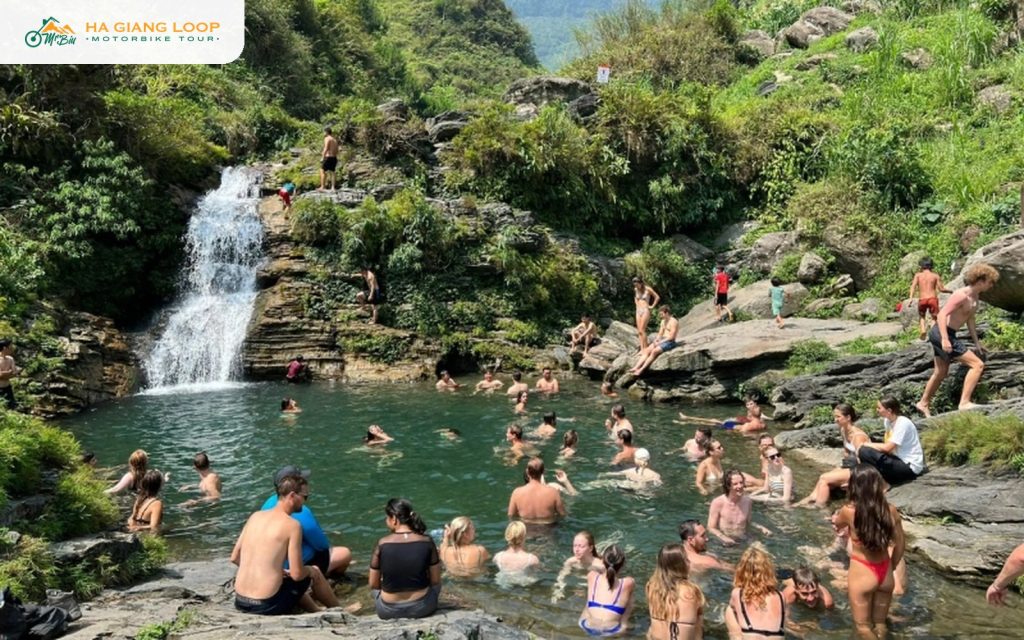
On the four-day tour, day one goes the other way: 120 kilometres from Ha Giang City over Thai An Pass, with its clear blue river running below the road, then deep into the Duong Thuong valley and on to Du Gia, where you swim at the fairy waterfall and eat dinner with a local family, followed by karaoke and rice wine. Day two is 110 kilometres from Du Gia through Ngam La village, rafting at Ngoc Long, lunch at Mau Due, and then the climb onto Ma Pi Leng Pass. You sleep in Dong Van.
So whichever you book, you ride Ma Pi Leng on day two and sleep in the same two homestay villages, just in a different order.
The direction is a deliberate choice on both tours rather than an accident of scheduling. Either way, Ma Pi Leng comes on day two, when everyone has a full day of mountain corners behind them. The three-day tour then finishes on the quiet Thai An valleys, an easy last day before the bus. The four-day tour puts the gentle valleys and the Du Gia waterfall on day one, while riders are still settling into the bike, and its extra night in Yen Minh means there is no rush on the way home.
The three-day itinerary rides home from Du Gia: 100 kilometres through the Lung Ho and Duong Thuong valleys, lunch in Thai An village, then over Thai An Pass and back into Ha Giang City in the afternoon. It is the gentlest day of the three, which suits a day with a bus to catch at the end of it.
The four-day version leaves Dong Van north-first. From Dong Van you ride up to Lung Cu Flagpole, the northernmost point of Vietnam, where the tower looks out across terraced fields to the Chinese border, and you stop at a Lo Lo village on the way. Only then do you come back through Chin Khoanh, Lung Cam, Pho Cao and Tham Ma, finishing the day at a homestay in Yen Minh instead of pushing on.

The final day is a relaxed 100 kilometres. You ride through pine forest and terraced fields to Lung Khuy Cave, the largest and most impressive cave on the loop, with a stalactite system worth the walk. Lunch is at Tam Son, then Quan Ba Heaven’s Gate for the Twin Mountains view, and Bac Sum Pass back into the city — arriving with time to spare rather than time to make up.
Four things, in order of how much they matter to most riders:
That third night deserves a sentence of its own. Homestay evenings on the loop follow a pattern — you arrive, you shower, you eat whatever the family cooked, and somewhere around the second glass the language barrier stops mattering. Two of those nights is a lovely experience. Three is when riders stop behaving like guests, start helping carry dishes, and swap contact details with people they will actually message a year later.
What the extra day does not buy you is a different Ha Giang. Both tours cover the Dong Van Karst Plateau and both cross Ma Pi Leng. If your budget or your calendar is tight, you are not missing the point of the loop by taking three days.
The four-day tour costs $34–36 more depending on how you ride — $162 against $128 to drive yourself, $196 against $160 for an easy rider. For an extra day of guiding, a third night of accommodation and another day of meals and fuel, that is a fair gap.
Both tours use the same bikes, Honda Blade 110cc, Future 125cc and XR 150cc, on the same terms: a standard bike carries no surcharge, a Honda Winner 150cc is 200,000₫ (about $8) a day and a Honda XR 150cc is 300,000₫ (about $12) a day.
Whichever length you choose, you can drive yourself or ride behind one of our drivers. Self-drive requires an international driving permit under the 1968 convention; the easy rider option requires no licence at all.
Our advice does not change with the tour length either. If you have not ridden a manual or semi-automatic bike in mountain conditions before, take the easy rider option. The passes are narrow, often wet and always unfenced, and riding behind someone who has known these roads their whole life is the difference between watching Ha Giang and watching the tarmac.
Both packages cover the motorbike with full fuel and motorbike insurance, an English-speaking local guide, homestay accommodation, meals throughout, protective gear and helmets, and entrance fees along the route. Your big luggage stays at our office in Ha Giang City.
Neither includes personal expenses, travel insurance, drinks other than water, tips for your rider, bus tickets or private rooms.
Booking terms are also identical: a 10–30% deposit confirms your place, deposits are not refunded but can be moved to another date or transferred to another person, and cancellations for bad weather or personal reasons are refundable with at least two days’ notice.
If you are slotting Ha Giang between Hanoi and Sapa and every day counts, book three days. You will see everything that made you want to come, and you will be on the evening bus with the photographs to prove it.
If you have the day spare, book four. Not because the three-day tour is missing something, but because the loop rewards the people who stop — and because there is a flagpole at the top of the country that you will otherwise only see in other people’s photos.
Both of our tours are run by a local family who have ridden these roads their whole lives. Same circuit, same homestays — the only choice is how much time you want to give it.
The classic loop, ridden clockwise: Quan Ba Heaven Gate, the Dong Van Karst Plateau, Ma Pi Leng, the Du Gia waterfall and Thai An Pass, with two homestay nights. Around 330 km, from $114. Best if your schedule is tight and you still want every headline view.
Everything above plus Lung Cu Flagpole, a Lo Lo village, the Yen Minh pine forest and Lung Khuy Cave, spread over a gentler pace. Around 440 km, from $154. Best if you would rather stop than hurry.
Self-drive or easy rider on both. Message us on WhatsApp at (+84) 3272 58338 or email mrbiu.booking@gmail.com and tell us your dates.
If Lung Cu Flagpole matters to you, yes without hesitation — the three-day tour cannot reach it. If you mainly want the riding and the big views, three days already delivers Ma Pi Leng, Nho Que and the Karst Plateau in full.
No. Both tours sleep in Dong Van and Du Gia and both cross Ma Pi Leng on day two, but the three-day tour rides the loop clockwise through Quan Ba first, while the four-day tour starts east through Thai An and Du Gia.
Roughly 100 to 120 kilometres a day, which is five to six hours on the three-day tour and four to five on the four-day. The distance is similar; the four-day version just spreads it out.
Sometimes, depending on group availability and homestay space. Ask as early as you can — the sooner we know, the easier it is to arrange.
Four days, if you can spare it. The shorter riding hours make a real difference when you are still getting used to mountain roads. Either way, consider the easy rider option.
Yes. Both cross Ma Pi Leng on day two and look down on the Nho Que River from the pass. Neither tour skips it.